Three Reference Sets, One Malaysian Reading: How We Rebuilt Genetic Ancestry for Malaysians
Our ancestry reading began on a published forensic reference from Yale University, moved to large public genome references, and now compares every person with a Malaysian reference built from 9,411 people in our Malaysian cohort. Each step made the answer clearer, and the last one made it Malaysian. Along the way we learned why a public reference on its own cannot see Malaysians, and that lesson is worth sharing with other research teams.
Case study · Research resource · Malaysian Genotype Dataset Browser
Step 1. A published forensic reference from Yale University
Our first ancestry reading used FROG-kb, the forensic ancestry reference kept by the Kidd Lab at Yale University. It holds published marker panels built to tell continents and peoples apart (the Kidd 55, the Seldin 128 and the SNPforID 34 panels), with frequencies for between 79 and 161 reference peoples. We added one people of our own in August 2026: a Javanese group counted from 227 openly published West Java genomes. That gave 80 peoples and 180 markers, of which about 149 can be read from a typical sample.
A panel of that size answers one question well: which peoples does this person look most like? It cannot say how much of a person came from where. Across 334 readings already delivered, 31 in 100 came back with a single name. The rest came back as a list of two to five look-alikes, often close East Asian peoples at similar shares, such as Hakka, Korean and northern Han Chinese for a Malaysian Chinese reader.
That list is honest. It is what 149 places can support. But it is not what a Malaysian reader is asking. The reference held one broad "Malaysians" group from published forensic work, and no separate group for Malaysian Chinese, Malay or Malaysian Indian people. From September 2026 a first version of our own three groups, at 120 markers, was shown beside the main reading.
Step 2. Large public genome references
Every sample we process holds far more than 149 readable places. So we read the same people again, from the same samples, at 51,956 places, against the 1000 Genomes reference: 2,504 people in 26 groups whose origins are recorded. We later repeated the check against a second, unrelated public reference, the modern people in Harvard's Allen Ancient DNA Resource, which holds 266 present-day groups.
The answer became far clearer. One clear group rose from 1.7 in 100 people to 99.3 in 100. A big step forward.
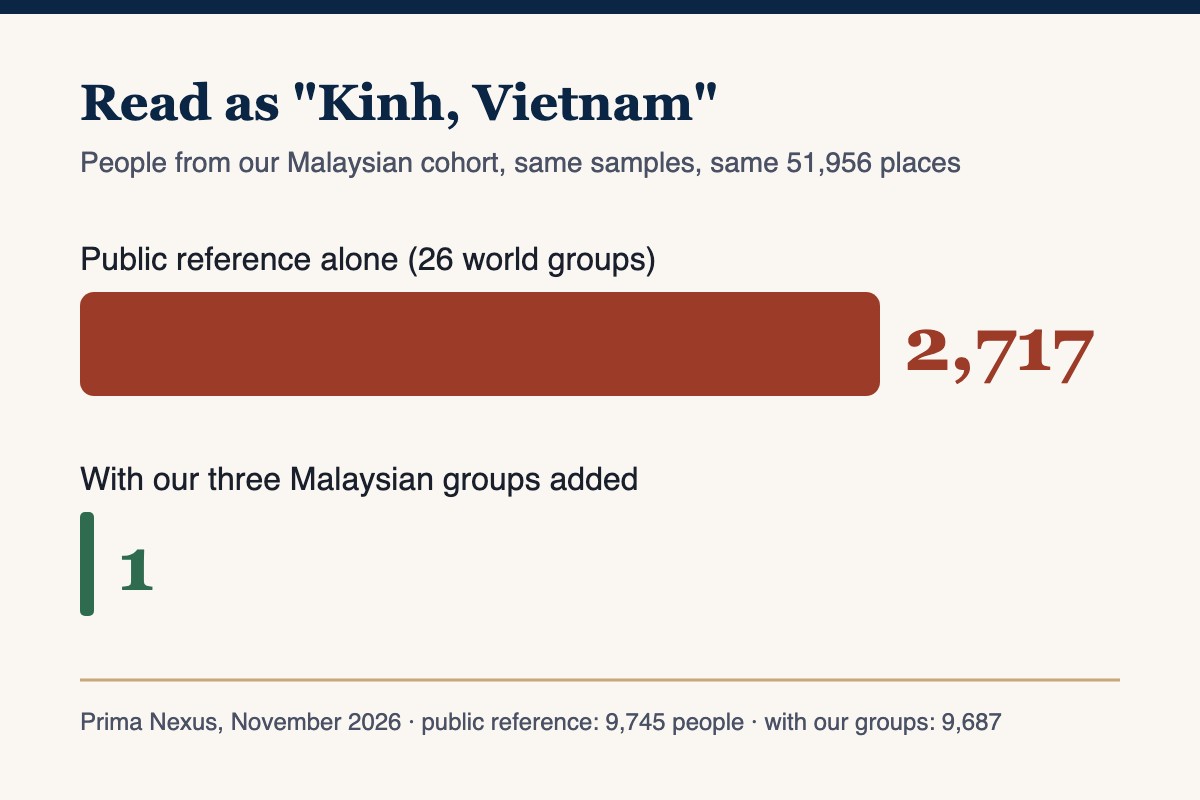
Why a public reference alone cannot see Malaysians: the 1000 Genomes reference holds no Malay, Malaysian or other Austronesian group. With no Malaysian group to compare against, 2,717 people from our Malaysian cohort were placed on the nearest group it does hold, "Kinh, Vietnam". A sharper reading needs a reference that holds the people being read. That is what step three adds.
Step 3. Our own Malaysian reference
The answer was not a cleverer method. It was a reference with Malaysians in it. Our cohort's DNA falls into three clear groups on its own, without anything participants were asked about themselves. We built those three groups from the group counts of 9,411 people in the screened 8 October 2026 build, at 675,938 places on the genotyping array we process samples on today, and placed them beside the 26 world groups. No individual's data leaves the counts.
With our three groups added, the number of people read as "Kinh, Vietnam" fell from 2,717 to 1, on the same samples and the same 51,956 places.
Checking the three groups before trusting them
Each person was first taken out of their own group's counts, so the test could not flatter itself. Then three checks.
- Do known public groups land where they should? 7 of 7. Both Han Chinese groups landed on our Malaysian Chinese group; Bengali, Gujarati, Punjabi, Sri Lankan Tamil and Telugu landed on our Malaysian Indian group (2,504 people, 561,859 shared places).
- Does each person find their own group? Malaysian Chinese 99.5%, Malay 99.1%, Malaysian Indian 62.2%. One clear name for 99.9% of everyone.
- Does it hold on a second, unrelated reference? Yes. Against the 266 groups of the Harvard resource, not one Malay cohort member landed on a Southeast Asian group, and 99.0% found their own.
The whole cohort, read as a mix
Between 23 and 24 November 2026 we read 9,687 of 9,746 people this way, each as a full mix that adds up to 100. Every line carries a range from 16 re-draws of the places read, so a reader can see how sure each part is. People whose roots lie mostly outside Malaysia are read against the world groups, not forced into ours. The largest part of each person's mix:
- One of our three Malaysian groups: 9,369 people (96.7 in 100)
- South Asian groups: 134 (of them Sri Lankan Tamil, 109)
- European groups: 124
- East Asian groups: 51 (Japanese 19, mainland Han 23)
- African or American groups: 9
What comes next
Our Malaysian Indian group, built from about 600 people, is still being checked before we call it final. The reference does not yet hold Orang Asli or Bornean groups such as Iban and Kadazan-Dusun; those readers see the nearest groups we hold.
What it means for research teams
Before trusting a reading that became more confident, ask what its reference contains, and check what it does with people it has never seen. A confident answer is not the same as a correct one.
The same reference work supports Malaysian research directly: ancestry checks for study cohorts genotyped on a common array, Malaysian group frequencies beside international ones, and a second look at samples whose ancestry an international reference cannot place. To talk about a project, contact us.
About Prima Nexus
Founded in 2014, Prima Nexus Sdn Bhd is a Malaysian research, scientific consulting and integrated research support company advancing scientific discovery and healthcare innovation. We provide end-to-end research solutions, from early-stage discovery and experimental design to cell-based studies, preclinical animal testing, clinical trials and commercialization. Our multidisciplinary expertise spans genomics, genetic applications, proteomics, molecular biology, stem cell research, bioinformatics and clinical research. Through strategic collaborations with universities, research institutions, industry and global technology partners, we connect scientific expertise and advanced technologies to accelerate research into real-world applications. Our collaborations have supported more than 150 papers in peer-reviewed journals and research teams at more than 40 institutions across Malaysia. More about Prima Nexus.